
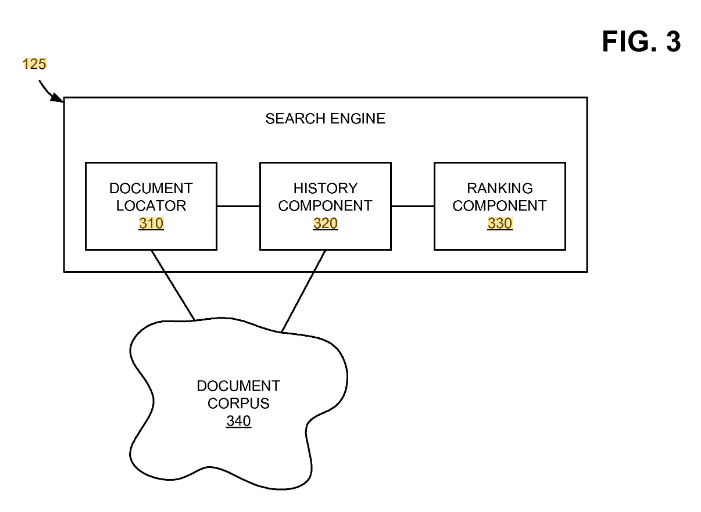
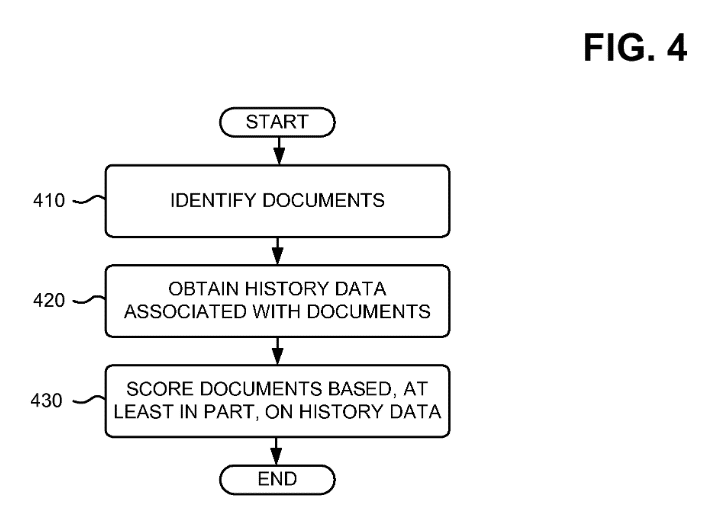
Google is trying to improve search quality by understanding the historical behavior of documents, not just their current content. Instead of asking “Is this page good today?”, the system asks “Has this page consistently demonstrated relevance, authority, trust, freshness, and user value over time?”
The background describes an information retrieval system that generates search results using historical data associated with documents — incorporating signals like document changes, link patterns, and user behavior over time to improve ranking quality.
Claims Overview #
Documents are scored using historical data associated with them to improve search results.
The system evaluates documents on advertisement-related factors (the extent of ads presented or updated, and advertiser quality) and link-based factors — comparing link quantities across time periods, weighting links, identifying stale documents from declining link counts, and adjusting scores accordingly.
Scoring mechanisms include lowering scores for stale documents, discounting or ignoring certain links, using weighted combinations for a final score, and ranking documents relative to one another.

The overall goal is to identify and appropriately rank outdated or stale content relative to genuinely current, valuable pages.
Scoring Criteria and Ranking Factors #
Extent of advertisement presentation and updates within a document, and the quality of the advertisers involved.
Traffic thresholds for advertising documents, and how much user traffic those documents generate.
Freshness of anchor text, tracked through the date the anchor text appeared or changed, the date the link itself appeared or changed, and the date the linked document changed.
Click distance — how many clicks or hyperlinks it takes to reach a page from a natural starting point like the homepage, which factors into how the system weighs that page.
Whether link and anchor-text contributions should be discounted or ignored, general historical data and document age, and whether recent text changes were significant enough to affect ranking.
How Is Spam Detected Using Historical Data? #
The system leans on pattern analysis over time: tracking user interaction patterns to flag suspicious activity, watching for content modifications that suggest manipulation, establishing baseline behavior so anomalies stand out, evaluating a source's reputation based on its track record, and folding freshness and update frequency into the spam-detection model.
What Role Does User Behavior Play in Freshness? #
Search result selection frequency — how often users choose a document from the results, used as a relevance/freshness signal.
Engagement time — how long users actually spend on a document once they arrive.
Traffic patterns — a large, sustained drop in traffic can suggest a document has gone stale or been superseded.
Click-through on ads — engagement with in-document advertising is treated as one further freshness indicator.
Significant, sustained drops in any of these engagement signals can lower a document's freshness score over time.
How Are Age Distributions Calculated? #
The system tracks when links to a document first appeared and feeds those dates into a function that models the resulting age distribution. Stale documents tend to show a very different pattern from consistently fresh ones — for instance, a document that keeps earning new links gradually over years looks very different from one whose link growth stopped abruptly. That distribution becomes one input into the overall ranking score, and it doubles as a spam signal: legitimate documents typically gain links gradually, while sudden unnatural spikes can indicate manipulation.
How Is the Weight of Historical Data Determined? #
Links are weighted by a freshness function based on the date of link appearance/change, the date of anchor-text appearance/change, and the date the containing document last changed — with the containing document's date treated as the more reliable freshness indicator, since good links tend to survive routine page updates.
Links can also be weighted by the trust level of the document that contains them (a government or major institutional source, for example, carries more trust) and by that document's overall authority.
Historical weight can be discounted or ignored if a domain's focus shifts significantly, if the document's content changes substantially, or if its anchor text changes significantly.
What SEOs Should Keep in Mind #
Google ranks the history of a page, not just its current version.
Build links consistently over time — sudden spikes can look unnatural.
Treat internal links and backlinks as part of your site's historical link graph.
Keep important content fresh with meaningful updates, not just a changed date stamp.
Avoid major topic shifts on established URLs — they can weaken the historical trust that URL has built up.
Earn and maintain genuine user engagement signals by creating content people actually read and use.
Monitor pages for traffic decline, link loss, and content staleness before rankings drop.
Focus on long-term topical authority and consistent quality, since historical data rewards sustained trust over short-term tactics.


No comments yet. Be the first to respond.